By Ed Ting
Updated 2/1/15

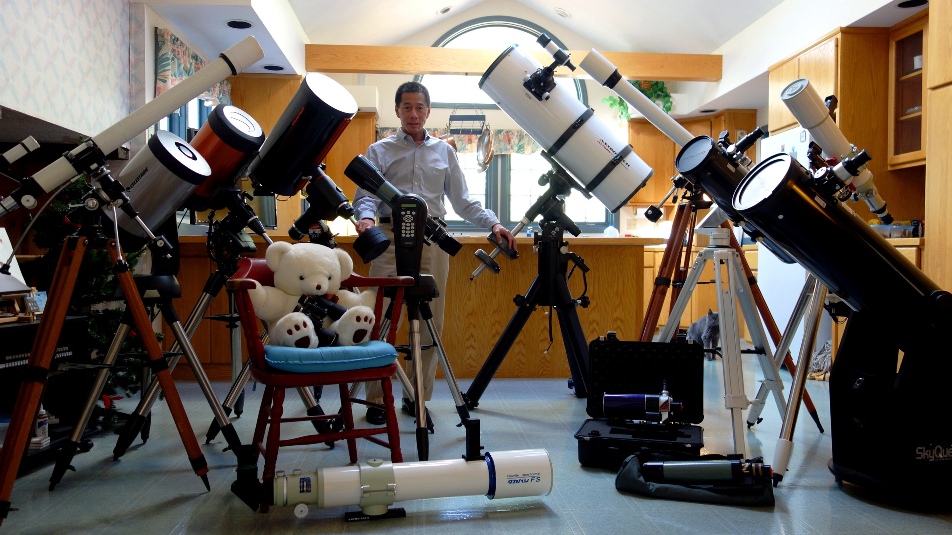
So, you've decided to take the plunge and buy a telescope -- congratulations! Astronomy can be a life long pleasure, with the right equipment. But what to buy? And how do you not wind up with a room that looks like the above? There's more equipment out there than ever before. This article will attempt to make some sense out of the seemingly huge selection of scopes and accessories.
Ready? Good. Let's begin.
First of all, some words of advice:
1) Learn to spot a few constellations and maybe a planet or two with the naked eye. If you can't point to M42, how do you expect to able to point a telescope (which has a much narrower field of view) there?
2) Subscribe to one of the two major magazines, Sky and Telescope or Astronomy. These will get you started not only with finding celestial objects, it will also acquaint you with the variety of equipment out there. Don't buy anything yet!
3) Join a club, or tag along on one of their observing sessions. This is the single best piece of advice I can give you. There is no substitute for spending time with real equipment out in the field. You may discover, for example, that you like the portability of Schmidt-Cassegrains, or that you enjoy the views through a good refractor, or that the big Dobsonian you saw in the catalog is much more of a handful than you imagined. Or whatever. There's no substitute for experience.
That said, your ideal first telescope may not be a telescope at all, but a pair of binoculars. Perhaps you have a pair lying around the house already. Most experienced astronomers keep a pair of binoculars close by, for quick peeks or for scanning the field of view before using their telescopes. The common recommendation is to get a pair of 7X50's, or at least, 7X35's. The first number "7" is the magnification, the second "50" is the aperture of each objective lens, in mm. You want the largest lenses you can comfortably hold.
Many astronomers opt for 10X50's, although you should make sure in advance that you can hold them steady at that power. It seems that the current trend is towards 10X50's, but I still like the traditional 7X50 size.
There are new "giant" binoculars which can give stunning views of the heavens, if you know how to use them. If someone offers you a view through one of these, by all means oblige, but hold off buying a pair for now. You'll know later if you want them. OK, so binoculars aren't exciting the way telescopes are. Before I leave the topic, allow me to make a final case for good binoculars: 1) Cheap binoculars are much, much more useful than cheap telescopes. Trust me on this one. 2) Good binoculars can last you a lifetime. As you trade up (or down) your telescopes, you'll still need a pair of binoculars for quick peeks and scanning. As a result, binoculars tend to be something you buy only once or twice. Finally, some find that a "spotting scope" - a small, stand-mounted telescope that can be used for astronomical and terrestrial purposes - can be a good stepping stone to a first telescope.
Is the primary function of a telescope really to make things look bigger? Not necessarily. The primary function of a telescope is to gather light. The more light a scope gathers, the more powerful it is. And remember, telescope apertures are circles, and the areas of circles increase with the square of the radius, so moving up in aperture, even modestly, can yield big results. Our hypothetical 7X50 binoculars (above) gather over twice the light of the 7X35's, even though they look about the same size. Put another way, the owner of an 10" Schmidt-Cassegrain who decides to upgrade to a 12" will see a 44% increase in light-gathering ability. Not bad for a 2" increase, eh?
So, you should buy the biggest telescope you can afford, right?
The answer, is an unqualified MAYBE, and for some people, the answer will be NO. But we're getting ahead of ourselves.
1) The refractor is what most people think of when they hear the word "telescope". Refractors gather light with an objective lens at one end and focus the light at the eyepiece at the other end. Refractors were almost extinct at one point, but modern glass elements (including an exciting new artificially grown crystal known as fluorite) have brought the refractor back to prominence.
Refractor advantages: Potential for the best images, no obstruction in light path.
Refractor disadvantages: Some secondary color ("chromatic aberration") still visible in all but the best units, large aperture instruments can be massive, most expensive of the three designs (often by a large margin), "Guilt By Association" with horrible department store refractors.

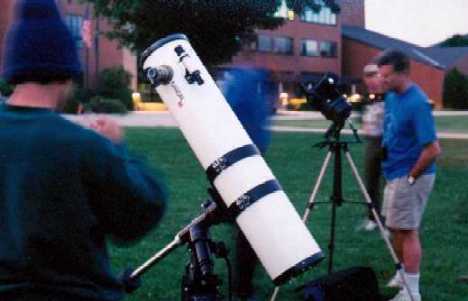
2) The Newtonian Reflector, invented by Sir Isaac Newton, uses a parabolic mirror at the end of a tube and focuses the light back at the front of the tube, where the eyepiece sits, after being deflected by a smaller secondary mirror in the light path.
Reflector advantages: Cheapest of the three designs (especially those on Dobsonian mounts), more portable than refractors of similar aperture, inherently color free (no chromatic aberration).
Reflector disadvantages: Secondary obstruction results in some loss of contrast, still quite large compared with Schmidt-Cassegrains, can require frequent collimation (alignment) of optics.
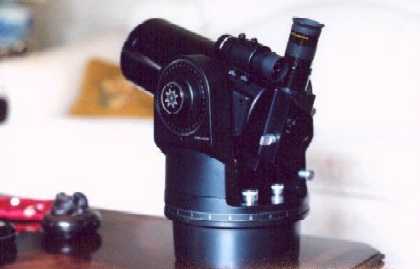
3) The Schmidt-Cassegrain and its derivatives (Maksutov-Cassegrain, Schmidt-Newtonian, etc.) use BOTH mirrors and lenses to fold the optical path back onto itself, resulting in a compact tube. The technical term for these scopes is catadioptrics, but since nobody seems to use this term, I won't. A Schmidt-Cassegrain telescope is sometimes simply referred to as an "SCT."
SCT Advantages: Most compact of the three designs, less expensive than refractors, huge assortment of after-market accessories, can be totally computer driven, very popular.
SCT disadvantages: More expensive than reflectors, images are potentially the worst of the three designs (notice I said "potentially!"), most subject to dew of the three designs.
Depends. The "right" telescope depends on you, your observing habits, and your financial situation. Back before 1990, picking a telescope used to be a simple matter. You started out with a 60 mm refractor (probably from a department store), then you upgraded to a 6" f/8 reflector from either Criterion or Meade, and if you stuck with it long enough, you eventually bought an 8" Schmidt-Cassegrain from Celestron.
My, how things have changed. Throughout the 1960 and 1970's, the Newtonian reflector ruled the amateur roost. From about the 1980's onward, astronomers flocked to the portability of Schmidt-Cassegrains as both Meade and Celestron duked it out to try and out-do one another on features. Then, the refractor, long given up for dead, came roaring back with the advent of ED and fluorite glass. Now, you see all three designs in use regularly. The advantages/disadvantages of each design are well-documented elsewhere, so I'll attempt to give you some "other" information which may be useful to you.
This is a tough one to answer, since everyone has their own priorities and preferences. Still, knowing what I know, if I were starting out today, I would probably get a 6" or 8" Dobsonian-mounted reflector. The fact that I am something of a "refractor guy" says a lot about this choice. A 6" Dobsonian is simple, cheap, and will teach you a lot. The simplicity part is important, since you will spend your time aiming and observing with your telescope, rather than playing around with the sometimes complicated controls on an equatorial mount. Beginners need early success, and the 6" or 8" aperture is big enough to throw up a bright image of most common celestial objects.
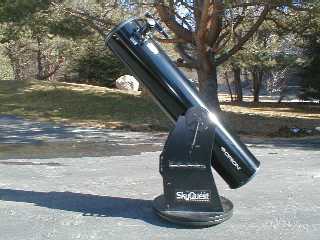
I like all the 6" Dobsonians from Meade, Celestron, Orion, and Discovery. Offshore manufacturing means that the same basic unit is now available under a variety of nameplates. You may find similar Dobsonian reflectors sold as Zhumell, Skywatcher, Bresser, Konus, Hardin, Apertura, and others, depending on where in the world you live. I like the Orion the best, but you can just pick one; they're all good. If you're feeling ambitious, get an 8" version. The differences between the brands show up mainly in the quality of the accessories. Look for a 6X30 finder (or larger), Plossl instead of Kellner eyepieces, and Pyrex instead of plate glass mirrors. If I were pressed to recommend one telescope for beginners, it would be the Orion Skyquest XT8. The scope weighs about 41 lbs and is about 4-5 feet high. The XT6/XT8 telescope is complete as shown, and simply sits on the ground. There is no need to purchase any additional mount or tripod.
Audiophiles have a saying that goes something like this: The stereo system which reveals the most music to you is the one you use the most.
For most of us, that's our car stereo.
Astronomy is a lot like that. The probability that a telescope will be used is inversely proportional to its size. This seems to apply to just about everyone, regardless of experience. I've carried on a correspondence with a fellow astronomer. He has an 18" "Luxo-Dob", I have a tiny TeleVue Ranger. Our conversations tend to go something like this:
Me: So, did you see Saturn last night?
Him: No, it was too cold out to go observing.
Me: Oh.
Him: But my 18" Dob blows your puny little 2.7" refractor out of the water, you teeny dweeb!
OK, so maybe it doesn't go exactly like that, but you get the idea. Sure, he's got me whipped on aperture, but I got in 2.7" worth of observing that night, and he got in zero.
Little scopes get used more often, and thus show you more. Your Luggability Tolerance may be different from mine, however, and that's where visiting public star parties becomes an invaluable experience.
The star parties also come in handy when I DO want to look through a big scope. I just look through someone else's. This way, I get my share of "big gun" observing time and I don't have to deal with the hassle of set up and break down.
For balance, I should state that I have recently learned to dodge this "bulk" issue with larger telescopes by placing them on rolling platforms with lockable castors. Go to your local lumber yard/hardware store and get 3/4"-1" thick plywood and four castors. Don't skimp on the quality of the castors; get the best ones the store carries. Also remember to use lock washers or the nuts will eventually work themselves loose. I can leave the 20" Obsession fully assembled in my garage, and when I want to use it I just roll the whole thing outside. I can be observing in less than 5 minutes. There is something rather nice about kicking a 20" Dob out the door and observing with it within a couple of minutes while your friends are still assembling their small equatorial mounts. This works so well, I built platforms for the rest of my scopes as well.
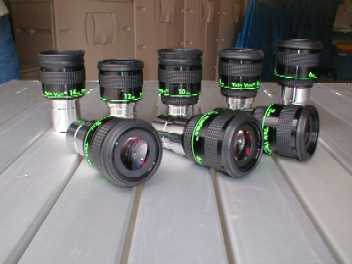
Here's one area where beginners tend to go overboard. You don't really NEED more than 3 or 4 carefully chosen eyepieces, a barlow, and perhaps a filter or two, but most of us eventually wind up with collections, some of them needlessly impressive. Still, the first accessory a newcomer buys is usually a new eyepiece. Below is a guide to various designs.
Ramsden and Huygenian are 2-element eyepiece designs. While simple, they exhibit narrow fields of view, have numerous aberrations, and terrible edge correction. Generally supplied only with the least expensive telescopes. While not of much use visually, they make good solar projection eyepieces (i.e. you can risk 'em). About $25-$40.
The Kellner is a three element design that shows an acceptable 40-45 degree FOV, and good correction of spherical and chromatic aberration. Offshoots include the Meade MA, Celestron SMA, and Edumnd RKE. A decent general-purpose eyepiece for the price. About $30-$50.
Orthoscopic eyepieces were once considered the best for general use, but have lost some of their luster compared with newer Plossl designs. Using 4 elements, they are still popular for planetary work. They are well corrected throughout their 45 degree FOV. About $40-100.
The Plossl seems to be the most popular eyepiece design today. Using 4 or 5 elements, they are very well-corrected and have a wider (50-52 degree) FOV than Orthoscopics. However, some models have shorter eye relief than equivalent Orthos. About $50-$150.
Erfles seem to have fallen out of favor these days. Using 6 elements, Erfles throw up a wide 60-65 degree FOV, with increasing distortions near the edge. Rapidly becoming extinct. About $75-$150. Newer designs, primarily from the efforts of TeleVue, are gaining in popularity. These include the 6 element, 67 degree FOV Panoptics (about $200-$400) and the 7-8 element, 82 degree FOV Naglers (about $175-$425). Both series are truly amazing. It is said that once you have looked through a Nagler, nothing else will be good enough for you. As a Nagler owner, I think they might have a point. And if you thought the Nagler eyepieces were impressive, wait until you see the new TeleVue Ethos line (just try not to look too hard at the prices.)
Sparked by the success of the TeleVue eyepieces, the Japanese have gotten into the act. The Meade Super Wides ($140-$300) and Ultra Wides ($170-$300) are virtual clones of the TeleVues. And Pentax's 6-7 element SMC-XL (about $250 each) are thought by some to exceed the performance of the TeleVues, especially at the lower focal lengths. Vixen's Lanthanums ($100-$200) and TeleVue's Radians ($250) throw out a generous 20 mm of eye relief regardless of focal length, and are a godsend to those who must wear glasses while observing. In recent years, the Chinese have gotten into the game. Eyepieces from Astro-Tech, Explore Scientific, and others are offering excellent value for the money, while getting better with each revision.
Many observers find a barlow lens to be a valuable accessory. Inserted between the focuser and your eyepiece, a barlow will typically double or triple the magnification of any eyepiece. Thus, for $60-$100, you have effectively doubled the size of your eyepiece collection. Also, a barlow preserves the eye relief of your longer focal length eyepieces, thus reducing the amount of squinting you have to do. Having said that, a common beginner's mistake is to use barlows much too often, chasing high magnifications, resulting in shaky, fuzzy images. If you're new at this, keep the powers low for now. Your eyes (and your patience) will thank you.
Again, don't go crazy with eyepieces. It is especially important not to go chasing high magnifications - beginners make this mistake a lot. Keep in mind that most of the time (75% - 80% of the time) you will be using your lowest power eyepiece. I'm even more extreme this way than most observers. I am at my lowest power 90% - 95% of the time.
Next to "What telescope should I buy?" this is the most common question I usually get asked. This is a tougher question to answer than you may think. What you can see depends on a lot of factors, including the type of telescope you bought, the quality of your local seeing conditions, and your level of skill.
Since the quality of your instrument and conditions are largely out of your control, it would make sense to hone your observing skills. Sadly, I don't see this happening much anymore. Observers, eager for instant results, often upgrade to larger and larger telescopes without bothering to learn how to "see" properly.
Seeing well is both an art and a skill. You need to spend lots of quality time with your telescope. The more you look, the more you will see, and the better you will get. As a result, an experienced observer might enjoy deep sky objects in an 80 mm refractor, while a beginner with a light bucket next door is still struggling to find the Orion Nebula. Astronomy is a patient hobby. Don't be in too great a rush. The cosmos will still be there tomorrow. OK, now that the lecture is over, here's what you can see with a typical 6" reflector under reasonably good skies:
Have Realistic Expectations
I've been getting this a lot lately. In this age of video games and HDTV, people are starting to get wildly unrealistic expectations as to what they'll see. At least once a week, I get an email from an excited newcomer looking for a Call of Duty - like experience. Know this: most objects in your telescope will appear to be nothing more than dim, gray, featureless blobs. The excitement of visual astronomy is in knowing and pondering what those objects are. Below are some simulated images to let you know what to expect.
Modern image of Saturn (photo courtesy Joe Roberts):

Simulated image of Saturn through a 6" telescope at about 100X:

Professional long exposure image of M31, the Andromeda Galaxy:

Simulated image of M31 through a 10" telescope at low power:

Professional image taken of M13, the globular cluster in Hercules:

Simulated image of M13 through a 6" telescope at low power:

Hopefully you get the idea.
What about Astrophotography?
Don't.
Just don't.
I know, I know, you want to. The urge to photograph what you see is almost irresistible. The problem is, beginners have no idea what they're getting into. This is way more involved than you can possibly imagine. You've got a lot to learn, between the night sky and your new telescope. Don't complicate matters by getting involved with astrophotography. What's more, photographers, as a rule, have a harder time adjusting to astrophotography, than "civilians." They assume their knowledge of conventional photography will shorten the curve for them, but usually the opposite happens. Next to department junk-scopes, astrophotography is the #1 reason people drop out of the hobby.
My friend and fellow club member Herb B, who is really good at this, estimates he's spent tens of thousands of dollars, over a decade of his life, and untold thousands of rejected images, to get where he is today. When new members excitedly ask him for advice on getting started in astrophotography, his usual response is this:
"Don't."
In summary, here are the prominent points given above:
1) Binoculars, even cheap ones, are sometimes a good substitute for a cheap telescope. In addition, binoculars are almost always good companions to a telescope.
2) Avoid department store, toy store, and "Nature/Science" store telescopes. I cannot restate this strongly enough: STAY AWAY from department store telescopes!
3) The primary purpose of a telescope is to gather light. Thus, all other things being equal, beginners should buy the largest aperture telescope they can afford. A 6" Dobsonian reflector is an excellent first telescope.
4) BUT, if the instrument is too large, you may never use it. Be realistic about what you're willing to lug around.
5) You don't need more than 3 or 4 carefully chosen eyepieces in your collection at first. The minimum quality you should consider are Kellners (and their offshoots). A barlow is useful tool for doubling your collection at minimal cost.
6) If I were pressed to recommend one telescope for a beginner, it would be a 6" or 8" Dobsonsian reflector ($300-$400.)
7) If you're interested in daytime terrestrial viewing, you need something called a "spotting scope" which is out of my area of expertise.
8) Avoid any thoughts of astrophotography.
End Beginner's Advice